
Do Testosterone Boosters Actually Work? What the Clinical Evidence Shows (Not the Marketing)

Key takeaways
- An FDA-associated review found zinc, not marketed herbs, drove whatever effect these products showed.
- Only 19% of the 191 studies behind top-selling boosters were in humans; just 30% of those found an increase.
- Ashwagandha has the strongest repeated signal but was mostly studied in men with fertility issues.
- High review ratings track subjective feeling, not measured testosterone.
Short answer: no, not for most men — and the ingredient that does the most work in most formulas isn't the one on the front of the label. The scientific consensus across FDA review, independent ingredient audits, and systematic reviews is that over-the-counter testosterone boosters lack solid evidence of raising testosterone in men who aren't already deficient in something specific. That doesn't mean every ingredient is useless — it means the category's marketing runs well ahead of its data, and knowing exactly where the gap is lets you actually shop it.
What the FDA's own review found
A 2015 FDA-associated study looked at over-the-counter testosterone boosters and found no quantifiable benefit from the products as marketed. The more specific and more useful finding: where an effect showed up at all, it tracked back to the zinc content of the formula — not the herbal ingredients the label puts front and center. A capsule marketed on tribulus or a "proprietary matrix" may be doing whatever it does because of the cheap mineral buried in the fine print.
The 191-study reality check
An independent analysis evaluated 50 branded "testosterone booster" supplements and found that only 24.8% contained ingredients with credible evidence of raising testosterone; 61.5% relied on ingredients with weak or no supporting evidence. Zooming into the top 5 best-selling testosterone boosters on Amazon specifically, researchers traced 191 studies behind their active ingredients — and just 19% of those studies were conducted in humans at all (the rest were animal or in-vitro). Of the human studies, only 30% reported a testosterone increase; 3% reported a decrease; 46% found no effect; the remainder were indeterminate.
Put differently: for every human trial that found a testosterone-boosting effect from a common ingredient, roughly two found nothing, and the underlying evidence base is mostly non-human to begin with. A grading pass on the same ingredient set found 19% earned an "A" for strong, repeated positive evidence — the rest landed in C/D territory: contradicted, negative, or simply lacking.
The one exception worth taking seriously
Ashwagandha is the ingredient that comes closest to clearing the bar. A 2022 review found evidence that ashwagandha may raise testosterone, luteinizing hormone and follicle-stimulating hormone after around 90 days of use — but the underlying trials mostly enrolled men with infertility or low sperm count, so the result may not generalize to a healthy 35-year-old buying a bottle for energy. Only one of the trials in that review was fully double-blind, which leaves real room for bias. It's the strongest single result in the category, not a settled one.
Reviews vs. reality
If the clinical case is this thin, why do these products carry thousands of glowing reviews? A peer-reviewed analysis compared consumer-review sentiment against the clinical literature for the top-selling boosters and found the top 5 products averaged 2,761 reviews at 4.56 stars — a strong on-paper satisfaction signal. But that satisfaction runs almost entirely on subjective proxies (energy, mood, gym performance) rather than measured testosterone, and the same researchers filtered out unreliable reviews using third-party tools before even reaching that number. High star ratings and weak clinical evidence aren't contradictory; they're measuring different things. A capsule that does nothing to your testosterone can still make you feel like it's working through better sleep habits formed around a routine, a training push that coincides with starting the bottle, or simple placebo — none of which show up in a serum test.
Who this doesn't apply to
None of this touches prescription TRT for men with clinically diagnosed hypogonadism, which is a different category with real trial support for improvements in libido, bone density, muscle mass and mood — under medical supervision, after an actual blood test confirms a deficiency. If you suspect low testosterone, that test is the step that over-the-counter marketing consistently tries to skip past. We cover the practical difference in our natural booster vs. TRT comparison.
So is any of it worth taking?
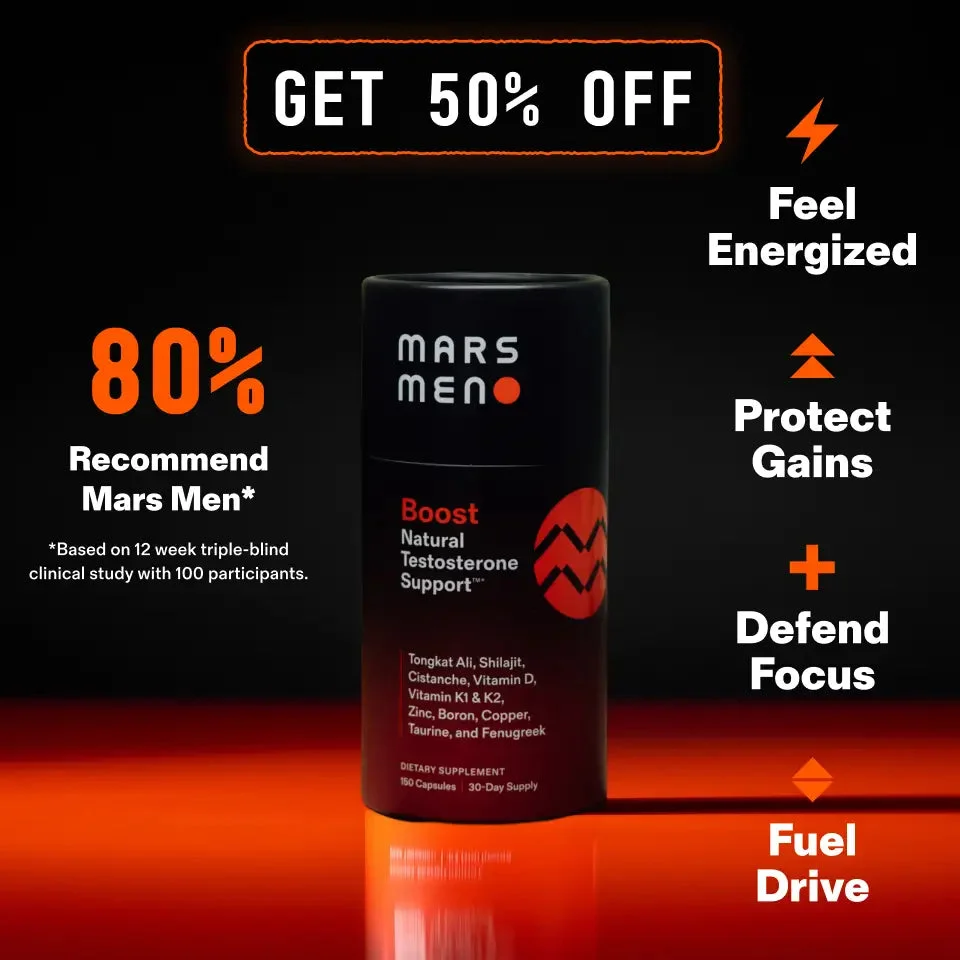
Narrowly, yes — for a specific reason, not the reason on the label. If a blood panel shows you're actually low in zinc or vitamin D, correcting that deficiency has real supporting evidence and a testosterone-adjacent upside as a side effect of fixing the shortfall. Ashwagandha, dosed near the studied range, is the one botanical worth a genuine trial. Everything else on a typical label — the proprietary blends, the ingredients graded C or D, the doses that don't match any trial — is there to lengthen the bottle, not the effect. We built our own Natural Testosterone Support around that filter: zinc, ashwagandha, and vitamin D3, and nothing added just because a competitor's label has it.
Bottom line
Most testosterone boosters underperform their marketing because most of their ingredients underperform the marketing — not because the entire category is a scam. The honest use case is narrow: correct a real, measured deficiency, take ashwagandha for its own modest but repeated signal, and treat everything else on the label as unproven until a better trial says otherwise.
Key takeaways
- An FDA-associated review found zinc — not the herbal ingredients marketed on the front of the label — drove whatever effect these products showed.
- Across 191 studies behind the top 5 best-selling boosters on Amazon, only 19% were human studies, and just 30% of those found a testosterone increase.
- Ashwagandha has the strongest repeated signal of any common ingredient, but the supporting trials mostly studied men with fertility issues, not healthy adults.
- High star ratings and weak clinical evidence aren't contradictory — reviews mostly track how someone feels, not their measured testosterone.
Frequently asked questions
Do any testosterone boosters actually raise testosterone? Some ingredients do, in some men — mainly zinc in men who are deficient, and ashwagandha with a modest, repeated effect. Most branded formulas dilute those with ingredients that have weak or contradicted evidence.
Why do these products have so many positive reviews if the evidence is weak? Reviews mostly track subjective feeling — energy, mood, gym performance — not measured serum testosterone. The two can move independently.
Should I get tested before buying a booster? Yes. A blood panel is the only way to know if you're correcting an actual deficiency (where the evidence is real) or chasing a number that isn't low in the first place.